
Question 1

/ 1 pts
As an elected official, you have been informed that real GDP is below its potential and that action should be taken to encourage economic growth and bring the economy to its long-run equilibrium. If the marginal propensity to consume is 0.8 and the amount of new government spending is $600 billion, by how much would the economy be stimulated?

$480 billion

$600 billion
Correct!

$3,000 billion
FEEDBACK: First calculate the multiplier. This is found by using the equation, ms = 1 ÷ (1 – MPC). With a marginal propensity to consume of 0.8, the multiplier is 5. An increase in government spending of $600 billion multiplied by the multiplier results in a $600 billion * 5 = $3,000 billion increase in real GDP.

$300 billion

FEEDBACK: First calculate the multiplier. This is found by using the equation, ms = 1 ÷ (1 – MPC). With a marginal propensity to consume of 0.8, the multiplier is 5. An increase in government spending of $600 billion multiplied by the multiplier results in a $600 billion * 5 = $3,000 billion increase in real GDP.

Question 2

/ 1 pts
During the fall of 2007, the United States economy began a descent into deep recession.  As a result, the federal government and the Federal Reserve took action to stimulate economic growth.  Which of the following would have been an appropriate fiscal policy?

the Federal Reserve increasing the money supply to reduce the interest rate

the federal government increasing marginal tax rates

the federal government increasing its regulation of banks
Correct!

the federal government spending more money to build more infrastructure
FEEDBACK: Fiscal policy involves the use of spending or taxation by the federal government.  During the Great Recession, the federal government provided tax refunds to all taxpayers and increased spending to build infrastructure. Both actions represent a form of fiscal policy.

FEEDBACK: Fiscal policy involves the use of spending or taxation by the federal government.  During the Great Recession, the federal government provided tax refunds to all taxpayers and increased spending to build infrastructure. Both actions represent a form of fiscal policy.

Question 3

/ 1 pts
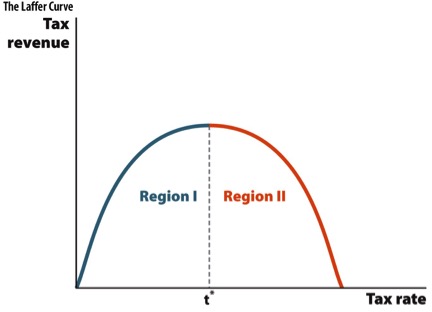
In a bid to be re-elected, you promise both a lower tax rate and greater tax revenue. You would only be able to back up your answer if:
(Use the Laffer curve, shown here, to support your answer.)
16_hw_ma_fig2
Click to view larger image.

the current tax rate is in Region I of the Laffer curve.
Correct!

if the current tax rate is in Region II of the Laffer curve.
FEEDBACK: If the tax rate is in Region I of the Laffer curve, tax revenues would increase as the tax rate falls, and you wouldn’t be able to back up your promise to voters. But if the tax rate is in Region II of the Laffer curve, tax revenue would increase as the tax rate falls, and you’d keep your promise. This is because very high taxes are a disincentive for earning income. Lowering those taxes will lead people to work more, earning enough extra taxable income that the government takes in more revenue than they did with the higher tax rate.
the current tax rate is in either region on the Laffer curve.

if the current tax rate is exactly t*, at the midpoint of the Laffer curve.

FEEDBACK: If the tax rate is in Region I of the Laffer curve, tax revenues would increase as the tax rate falls, and you wouldn’t be able to back up your promise to voters. But if the tax rate is in Region II of the Laffer curve, tax revenue would increase as the tax rate falls, and you’d keep your promise. This is because very high taxes are a disincentive for earning income. Lowering those taxes will lead people to work more, earning enough extra taxable income that the government takes in more revenue than they did with the higher tax rate.

Question 4

/ 1 pts
16_hw_ma_fig3
Click to view larger image.

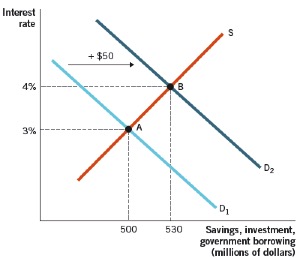
Suppose a small country is in recession and the government decides to increase spending to boost the economy, and decides to borrow $50 million to build statues of famous economists. Given this knowledge, and based on the graph above, which of the following statements is true?

Consumption will increase by $30 million

Investment spending will increase beyond $530 million

Correct!

Investment spending will decrease to $480 billion

FEEDBACK: Originally, the market is in equilibrium at point A, with an interest rate of 3% and savings and investment being equal at $500 million. Then the demand for loans increases by $50 million at all points when the government borrows $50 million. This change moves the market to a new equilibrium at point B. Government spending (G) will increase by $50 million. Total savings will increase from $500 million to $530 million, which means that total savings will increase by $30 million and consumption (C) will fall by $30 million. But because the government is borrowing $50 million of the savings, private investment (I) will fall to $480 million, a decrease of $20 million. All of this means a net change of zero in aggregate demand
(AD).

There is a net change in aggregate demand of +30 million

FEEDBACK: Originally, the market is in equilibrium at point A, with an interest rate of 3% and savings and investment being equal at $500 million. Then the demand for loans increases by $50 million at all points when the government borrows $50 million. This change moves the market to a new equilibrium at point B. Government spending (G) will increase by $50 million. Total savings will increase from $500 million to $530 million, which means that total savings will increase by $30 million and consumption (C) will fall by $30 million. But because the government is borrowing $50 million of the savings, private investment (I) will fall to $480 million, a decrease of $20 million. All of this means a net change of zero in aggregate demand
(AD).

Question 5

/ 1 pts
Suppose that the president has decided to increase government spending by building more libraries. The legislation was rushed through Congress and enacted without any delay. From here, the libraries will take 10 months to plan and 2 years to build.

Which of the following is true?

Correct!

The planning and building of the libraries represents an impact lag of this policy.
FEEDBACK: An impact lag would be present.  An impact lag is the time it takes after a policy is enacted for its effects to be completely felt in the economy. In this case, the policy is all about government spending, but because it takes a long time to build the libraries, it’s a while before all the money is completely paid to the construction workers and others doing the work.
The planning and building of the libraries represents a recognition lag of this policy.

This policy shows an example of automatic stabilizers taking effect.

This policy is contractionary.

FEEDBACK: An impact lag would be present.  An impact lag is the time it takes after a policy is enacted for its effects to be completely felt in the economy. In this case, the policy is all about government spending, but because it takes a long time to build the libraries, it’s a while before all the money is completely paid to the construction workers and others doing the work.

Question 6

/ 1 pts
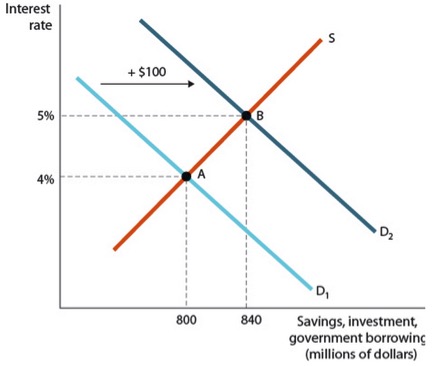
The graph below shows initial equilibrium in the loanable funds market at $800 million and an interest rate of 4%, point A. Now, assume that the government increases spending by $100 million that is entirely deficit-financed. The new equilibrium in the loanable funds market is now $840 million and an interest rate of 5%, point B.

16_hw_ma_fig1
Click to view larger image.

If we assume there was no government debt prior to the fiscal stimulus, determine the new quantities for the blanks below.
Savings: _______ million
Investment: _______ million
Private consumption decreases by: _______ million

$840; $840; $60

$840; $840; $40

$740; $740; $60
Correct!

$840; $740; $40
FEEDBACK: When the demand for loanable funds shifts to the right, total savings increases by $40 million, for a new level of savings of $840 million. Government spending increases by $100 million as stated in the question. This means that private investment has $740 million of savings available ($840 million – $100 million). Finally, private consumption falls by $40 million as anything not consumed is considered savings. Recall that total savings increased by $40 million.

FEEDBACK: When the demand for loanable funds shifts to the right, total savings increases by $40 million, for a new level of savings of $840 million. Government spending increases by $100 million as stated in the question. This means that private investment has $740 million of savings available ($840 million – $100 million). Finally, private consumption falls by $40 million as anything not consumed is considered savings. Recall that total savings increased by $40 million.

Question 7

/ 1 pts
The new classical critique of activist fiscal policy is theoretically different from the crowding-out critique. Crowding-out occurs when private spending __________ in response to government spending. Under the new classical critique, increased government spending leads people to __________ their current savings in order to help pay for higher taxes in the future, which increases the __________ of loanable funds.

decreases; decrease; supply

increases; increase; demand

decreases; decrease; demand
Correct!

decreases; increase; supply
FEEDBACK: Crowding-out occurs when increased government spending causes a decrease in private spending. The new classical critique explains how saving shifting occurs. As government spending increases, people know they will have to pay higher taxes eventually, which increases current savings. An increase in savings results in the increase in the supply of loanable funds.

FEEDBACK: Crowding-out occurs when increased government spending causes a decrease in private spending. The new classical critique explains how saving shifting occurs. As government spending increases, people know they will have to pay higher taxes eventually, which increases current savings. An increase in savings results in the increase in the supply of loanable funds.

Question 8

/ 1 pts
When fiscal policy is used to manage the economy, there are a number of factors that can delay its impact.

Which of the following is an example of a recognition lag?

After the policy takes effect, it takes time for its complete effects to ripple through the economy.

After an elected official proposes to spend more money to stimulate economic growth, it takes time for other elected officials to agree and take action.

After a law is passed that authorizes government spending, the bureaucracy within the government needs time to set up needed processes and procedures, and to identify areas that have the greatest need for federal spending.
Correct!

Although economic conditions seem bad enough to warrant government action, it takes time for economists to confirm that conditions are bad enough.
FEEDBACK: A recognition lag occurs over the time period it takes to recognize and verify the existence of a situation that may require government action. A recognition lag occurs when economists take time to determine if conditions are bad enough.

FEEDBACK: A recognition lag occurs over the time period it takes to recognize and verify the existence of a situation that may require government action. A recognition lag occurs when economists take time to determine if conditions are bad enough.

Question 9

/ 1 pts
When the economy is in a recession, expansionary fiscal policy can be used to stimulate and encourage economic growth. Which of the following scenarios represent expansionary fiscal policies from both a supply and demand perspective at the same time?

The government lowers tax rates.

The government lowers tax rates and issues a partial refund of taxes that have already been paid.

The government raises tax rates and reduces unemployment insurance payments.
Correct!

The Federal Reserve decreases the money supply and raises the interest rate while the government simultaneously reduces future taxes.
FEEDBACK: From a supply-side perspective, the government can lower tax rates. This gives people the incentive to work harder and earn more income. In the process, more output is produced, thus shifting the short- and long-run aggregate supply curves. From a demand-side perspective, either partially refunding previously paid taxes or undertaking an infrastructure project (increasing government spending) should increase aggregate demand. Both represent an expansionary fiscal policy.

FEEDBACK: From a supply-side perspective, the government can lower tax rates. This gives people the incentive to work harder and earn more income. In the process, more output is produced, thus shifting the short- and long-run aggregate supply curves. From a demand-side perspective, either partially refunding previously paid taxes or undertaking an infrastructure project (increasing government spending) should increase aggregate demand. Both represent an expansionary fiscal policy.

Question 10

/ 1 pts
Which of the following proposals is not likely to shift the aggregate supply curve?

An increase in social security payments

a 5% reduction in tax rates for those in the top 0.000001% of the income distribution
Correct!

Pell Grants, which are government subsidies for college education
FEEDBACK: Pell grants are supply-side subsidies with the intent to increase human capital, which will increase future innovation and production. In general, demand-side fiscal policy focuses on incentives to increase spending, while supply-side fiscal policy focuses on incentives to increase production.

a change in the supplier of school lunches at public schools

FEEDBACK: Pell grants are supply-side subsidies with the intent to increase human capital, which will increase future innovation and production. In general, demand-side fiscal policy focuses on incentives to increase spending, while supply-side fiscal policy focuses on incentives to increase production.

Question 11

/ 1 pts
Which of the following statements is true?

Contractionary fiscal policy will lead to an increase in government debt

Contractionary fiscal policy is used to stimulate an economy, and eliminate contractions
Correct!

Contractionary fiscal policy can prevent an economy from overheating
FEEDBACK: Contractionary fiscal policy would be implemented when the economy is in an expansion. The government will decrease government spending or increase taxes. If aggregate demand is too high, then the economy is operating past its natural equilibrium, with unemployment lower than the natural rate and output greater than the natural rate. This is unsustainable in the long run and causes pressures on prices to increase. Contractionary fiscal policy is used to keep prices under control.

Contractionary fiscal policy will lead to runaway inflation

FEEDBACK: Contractionary fiscal policy would be implemented when the economy is in an expansion. The government will decrease government spending or increase taxes. If aggregate demand is too high, then the economy is operating past its natural equilibrium, with unemployment lower than the natural rate and output greater than the natural rate. This is unsustainable in the long run and causes pressures on prices to increase. Contractionary fiscal policy is used to keep prices under control.

Question 12

/ 1 pts
Which of the following statements is true?

the Obama stimulus of 2009 had the same amount of funding as the Bush   package

The Obama stimulus package of 2009 had significantly less funding than the Bush 2008 package
Correct!

The Obama stimulus package of 2009  had significantly more  funding than the Bush 2008 package
FEEDBACK: The government enacted two significant fiscal policy initiatives. The first, signed in February 2008 by President George W. Bush, was the Economic Stimulus Act of 2008. The cornerstone of this act was a tax rebate for Americans. The overall cost of this action to government was $168 billion. In February 2009, less than one month after taking office, President Obama signed the American Recovery and Reinvestment Act (ARRA) of 2009. The focus of this second act shifted to government spending. Seventy percent of the ARRA cost was due to new government spending; the remaining 30% focused on tax credits. In addition, the size of this second fiscal stimulus— $787 billion—was more than four times larger than the first.


The Obama stimulus package of 2009 only favored rich people

FEEDBACK: The government enacted two significant fiscal policy initiatives. The first, signed in February 2008 by President George W. Bush, was the Economic Stimulus Act of 2008. The cornerstone of this act was a tax rebate for Americans. The overall cost of this action to government was $168 billion. In February 2009, less than one month after taking office, President Obama signed the American Recovery and Reinvestment Act (ARRA) of 2009. The focus of this second act shifted to government spending. Seventy percent of the ARRA cost was due to new government spending; the remaining 30% focused on tax credits. In addition, the size of this second fiscal stimulus— $787 billion—was more than four times larger than the first.

All papers are written by ENL (US, UK, AUSTRALIA) writers with vast experience in the field. We perform a quality assessment on all orders before submitting them.

Do you have an urgent order?  We have more than enough writers who will ensure that your order is delivered on time. 

We provide plagiarism reports for all our custom written papers. All papers are written from scratch.

24/7 Customer Support

Contact us anytime, any day, via any means if you need any help. You can use the Live Chat, email, or our provided phone number anytime.

We will not disclose the nature of our services or any information you provide to a third party.

Assignment Help Services
Money-Back Guarantee

Get your money back if your paper is not delivered on time or if your instructions are not followed.

We Guarantee the Best Grades
Assignment Help Services